

By Cole Maimann on Nov 21, 2026, 4:15:20 PM
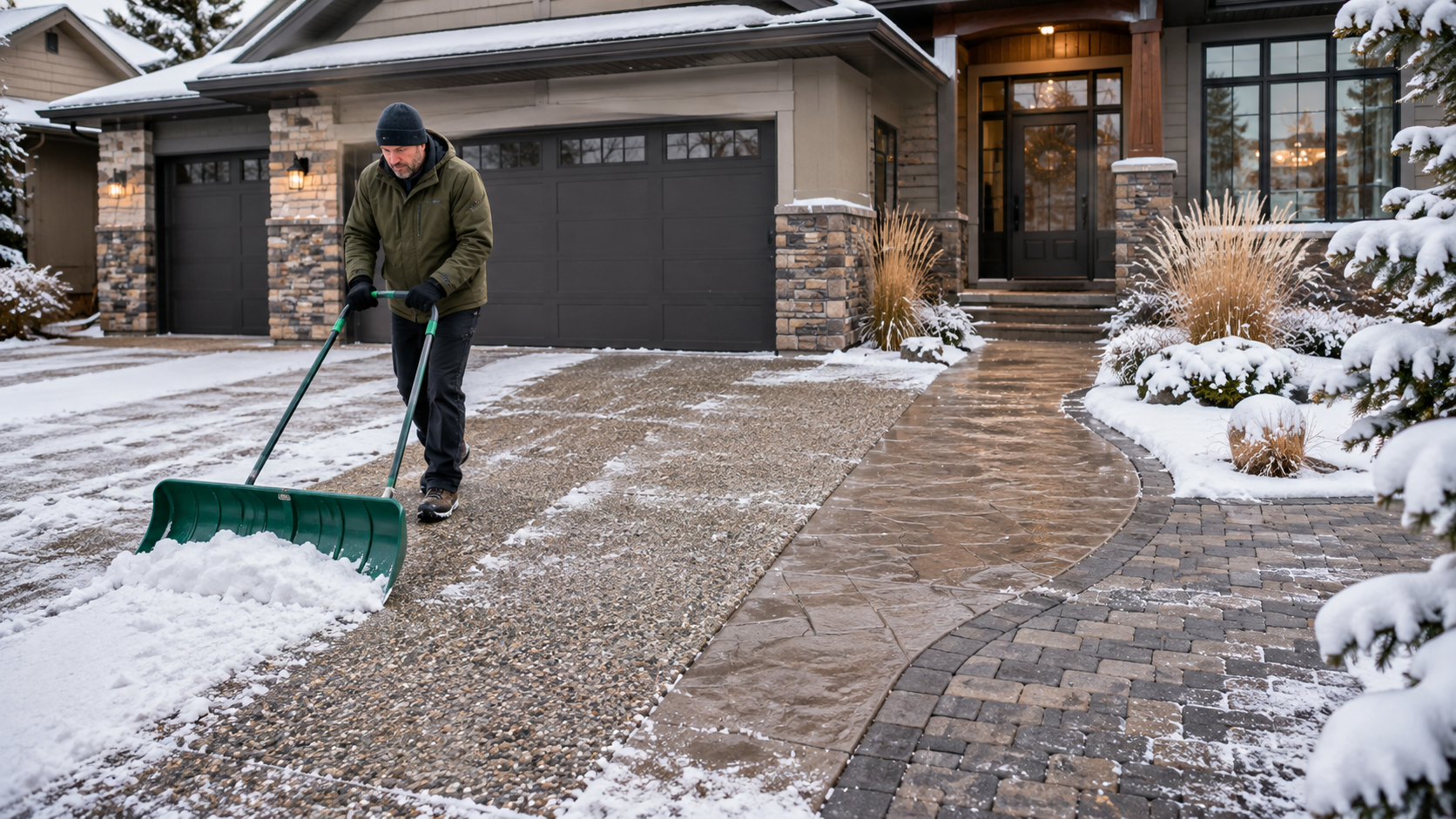
An Edmonton homeowner's guide to protecting decorative concrete, choosing the right snow removal equipment and managing winter ice safely.
The safest way to remove snow from exposed aggregate, stamped concrete and interlocking pavers is to clear it early with a plastic-edged shovel or snow pusher, before it becomes compacted. Avoid forcefully chipping bonded ice, and choose traction materials or de-icers according to your specific surface, its age and the manufacturer's recommendations.
But there's an important distinction: protecting your pavement and keeping it safe to walk on aren't always the same thing.
A driveway can look perfectly clear and still be slippery. Conversely, a thin layer of compacted snow may be safer to leave temporarily than to attack with a steel scraper that could permanently damage an expensive decorative finish.
In Edmonton, where snow, fluctuating temperatures and repeated freezing are part of winter, understanding that trade-off can save homeowners from costly repairs.
Here's what you need to know.
Why Decorative Concrete Needs Special Winter Care
Not all concrete is created equal.
A conventional broom-finished sidewalk, a decorative exposed aggregate driveway and a stamped concrete patio may share the same underlying material, but their surface textures and finishes respond differently to winter maintenance.
Exposed aggregate features visible stones embedded in the concrete surface. Stamped concrete has decorative patterns and may have a coloured or sealed finish. Interlocking pavers consist of individual manufactured units with joints between them.
These differences affect how snow removal equipment interacts with the surface.
Two Types of Damage to Watch For
Mechanical damage happens when equipment physically scratches, chips or abrades a surface. A steel blade catching a raised stone, a shovel striking a paver edge or aggressive ice chipping can all contribute.
Environmental deterioration develops through exposure to moisture, freezing temperatures and, in some circumstances, chemical de-icers.
One common example is concrete scaling: the gradual flaking or loss of material from the concrete surface.
According to the Michigan Concrete Association's technical guidance on scaling, moisture, freezing conditions, concrete quality, finishing and curing all influence how susceptible concrete is to this type of deterioration.
De-icing chemicals can also contribute to damaging exposure conditions.
That doesn't mean one application of ice melt will automatically destroy your driveway. It means the risk depends on several interacting factors.
The takeaway: Before choosing a snow removal method, consider the surface's age, condition, texture and any protective coating already applied.
A sealer may help limit moisture absorption, but it does not make concrete damage-proof.
How to Remove Snow From Different Decorative Surfaces
The first step toward protecting your driveway is identifying what you're actually clearing.
Different surfaces require different approaches, especially when dealing with compacted snow and ice.
Exposed Aggregate Concrete
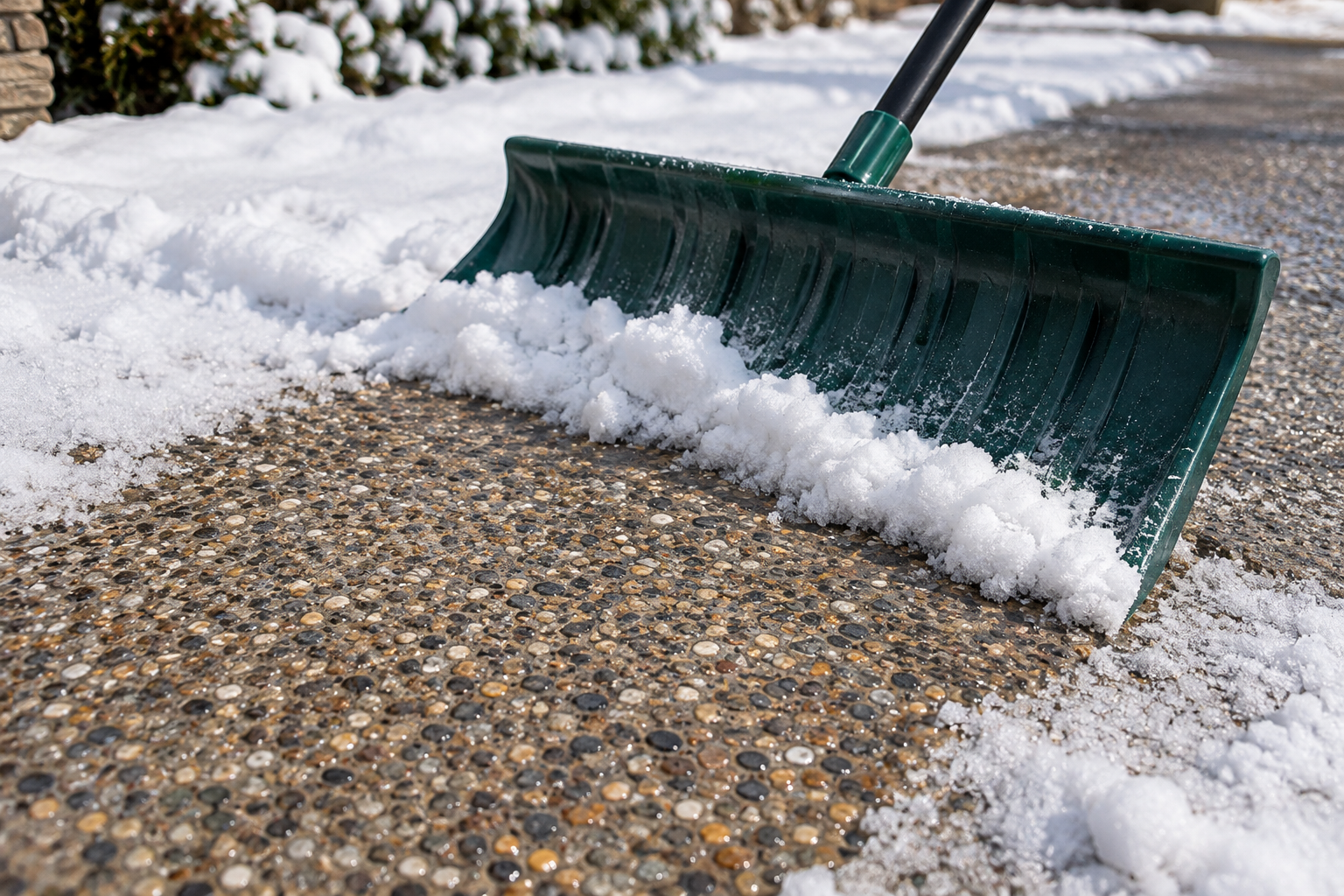
Exposed aggregate is popular for decorative driveways and walkways because of its distinctive appearance and textured finish.
That texture also creates challenges for snow removal.
Raised stones and surface irregularities can catch the edge of a shovel, particularly when the operator applies excessive downward pressure.
Our recommendation: Use a commercial snow pusher with a plastic edge and clear snow using smooth, controlled passes.
If the blade catches, stop and adjust its angle rather than forcing it forward.
Removing snow promptly is particularly helpful on exposed aggregate because foot traffic and vehicles can compress it into the textured surface.
For bonded ice, avoid striking the concrete with a metal scraper. If using a snowblower, check the manufacturer's instructions and ensure its scraper bar and skid shoes are appropriately adjusted.
Stamped Concrete
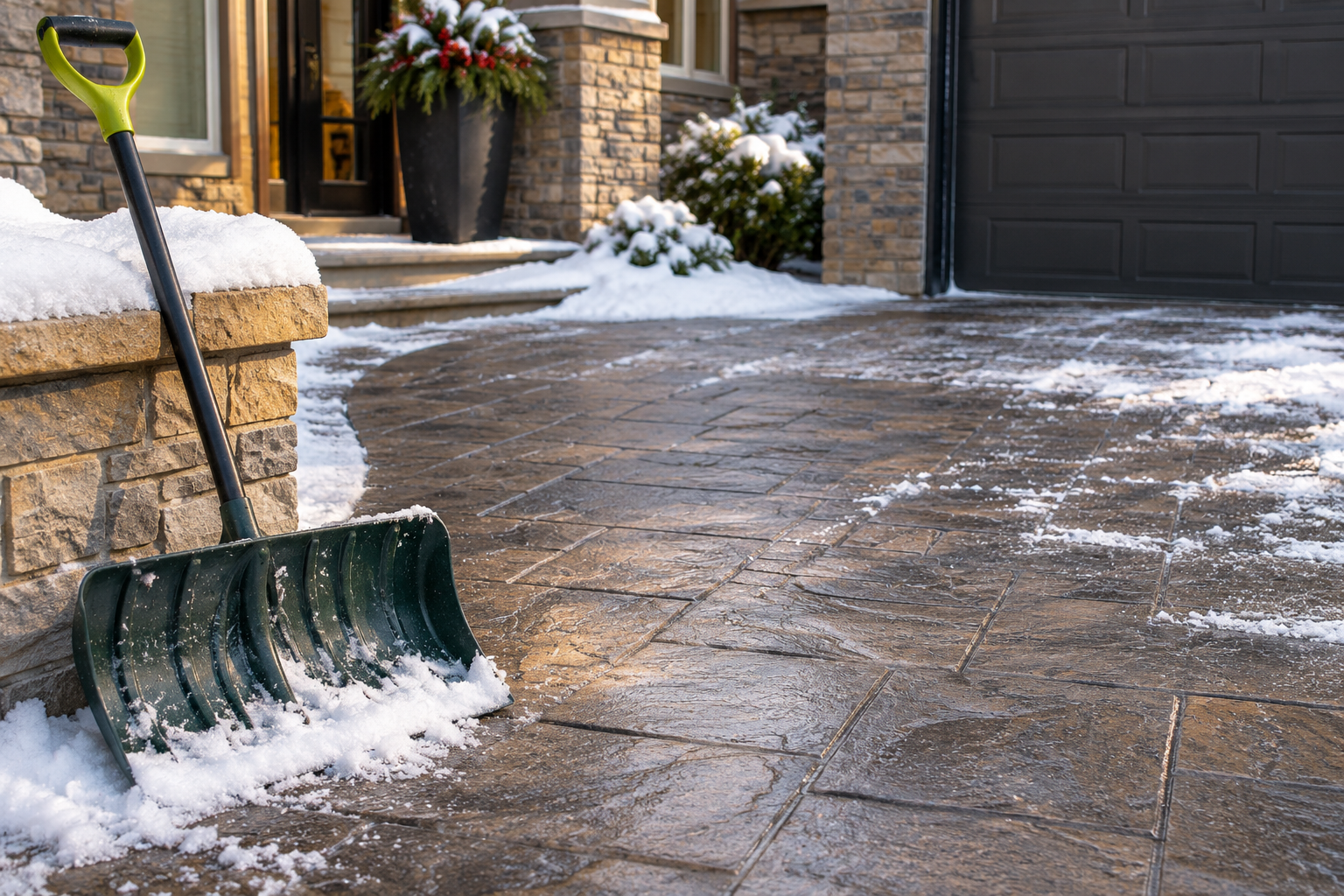
Stamped concrete is designed to resemble materials such as stone, brick or slate.
Its appearance may depend on decorative colouring, a surface sealer and the integrity of the stamped pattern.
The concern isn't simply scratching the underlying concrete. Aggressive removal can also damage an existing decorative finish.
Use a plastic or appropriate protective-edged shovel, keeping the working angle shallow and the pressure controlled.
Avoid repeatedly scraping recessed patterns in an attempt to remove every trace of snow.
If the coating is already peeling or worn, winter maintenance may accelerate visible deterioration. Check the installer or sealer manufacturer's recommendations before applying de-icing products.
Conventional and Permeable Interlocking Pavers
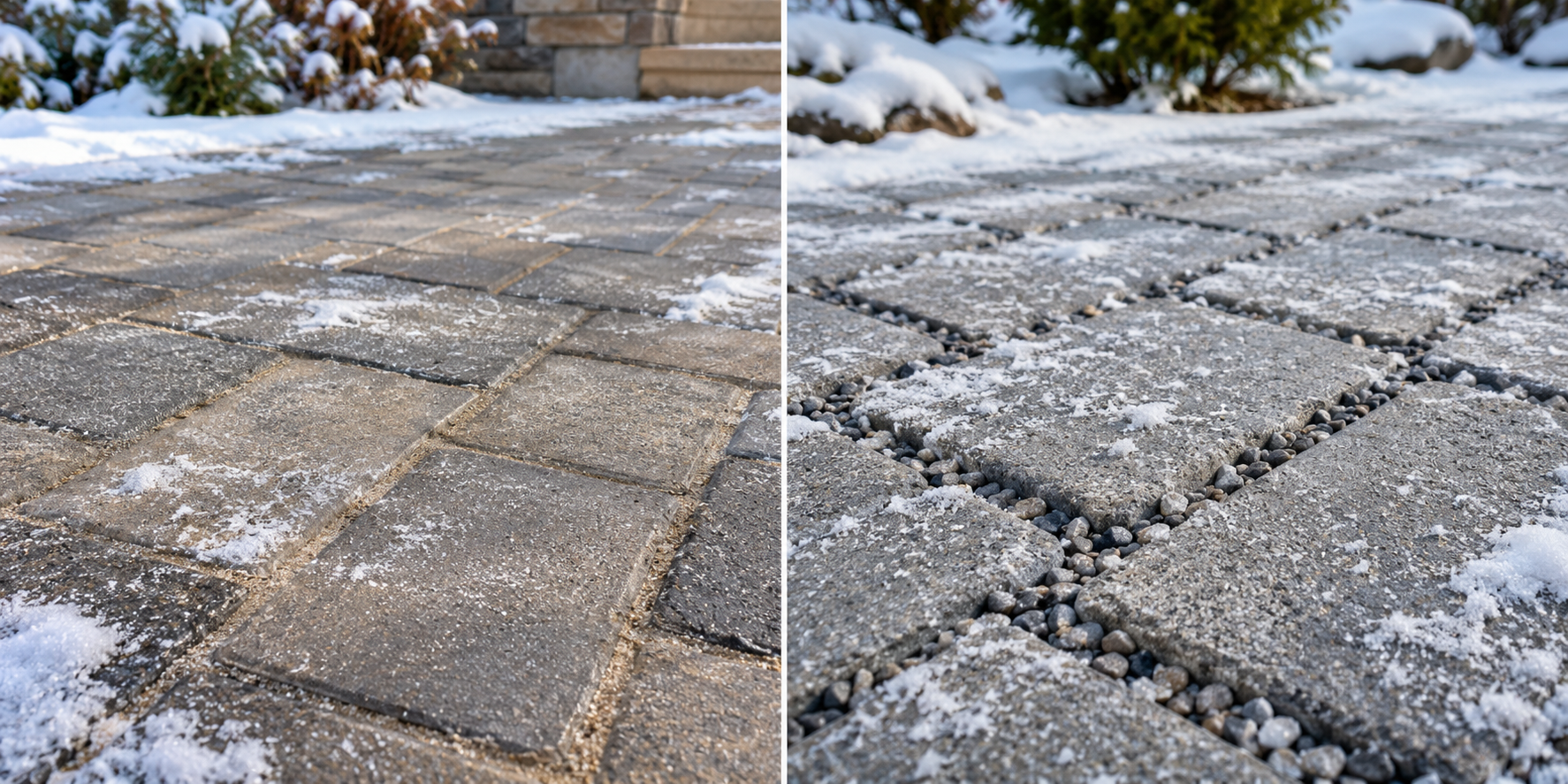
Interlocking pavers introduce another consideration: the joints between individual paving stones.
Conventional concrete pavers often have sand-filled joints.
Permeable interlocking concrete pavement is different. It uses open, stone-filled joints that allow water to pass into a drainage structure beneath the surface.
That distinction matters enormously when selecting traction materials.
For conventional pavers, suitable traction sand may be appropriate.
For permeable pavers, however, the Concrete Masonry & Hardscapes Association (CMHA) advises against traction sand because it can clog the joints and reduce the pavement's ability to drain water.
Compatible jointing aggregate may be a better alternative.
Regardless of the system, watch for uneven or raised pavers that could catch a shovel blade. If joint material becomes displaced during winter, arrange appropriate maintenance once conditions permit.
A Quick Guide to Protecting Your Surface
Different materials call for different tools, traction products and precautions.
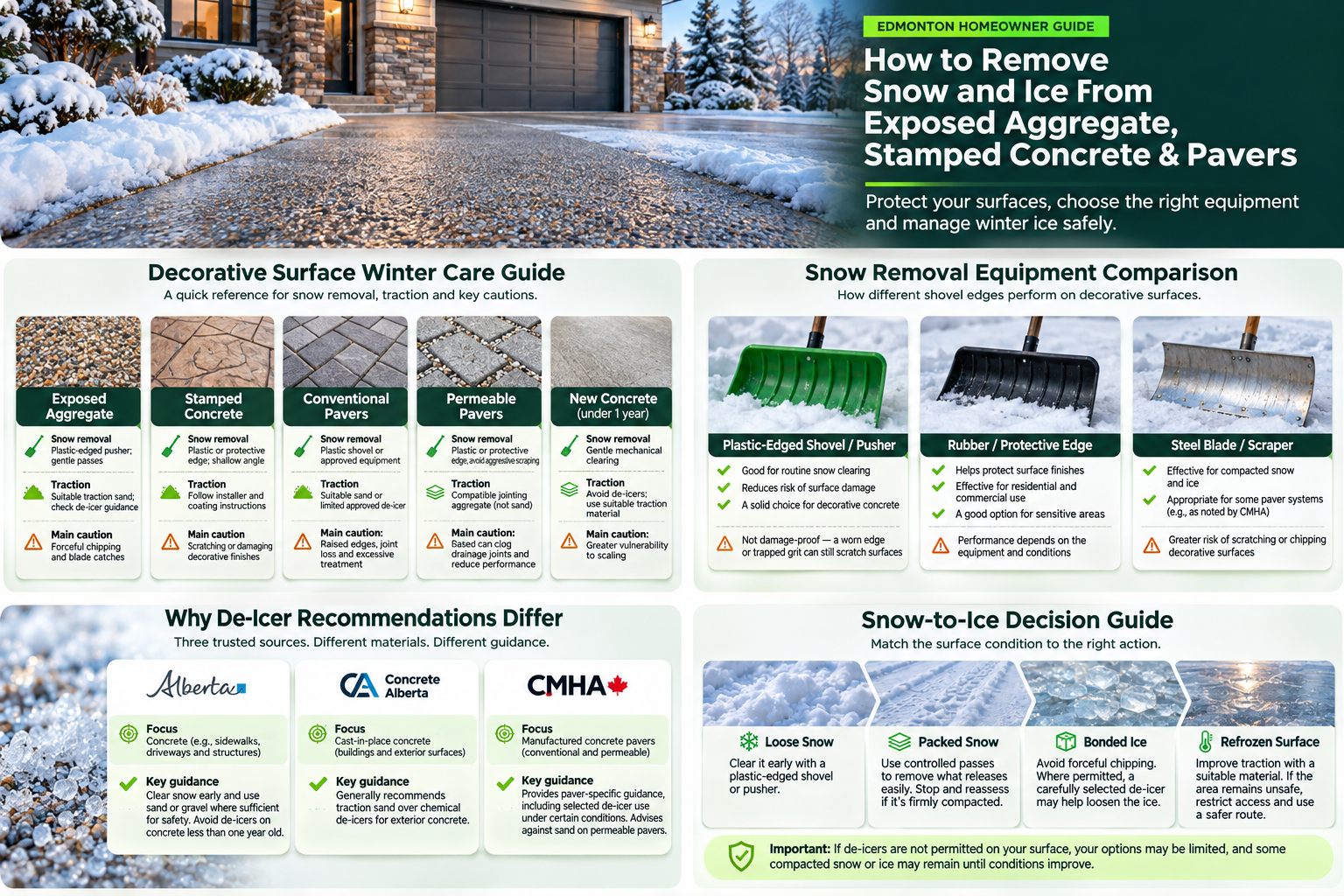
One particularly important exception is newly placed concrete. Alberta Infrastructure recommends avoiding de-icing chemicals on concrete less than one year old.
This precaution applies to newly placed concrete; it should not automatically be extended to every newly installed factory-cured paving product.
Plastic vs. Metal Snow Shovels: Which Is Better?
When it comes to decorative surfaces, the material at the bottom of your shovel matters.
But so does how you use it.
Plastic-Edged Snow Pushers
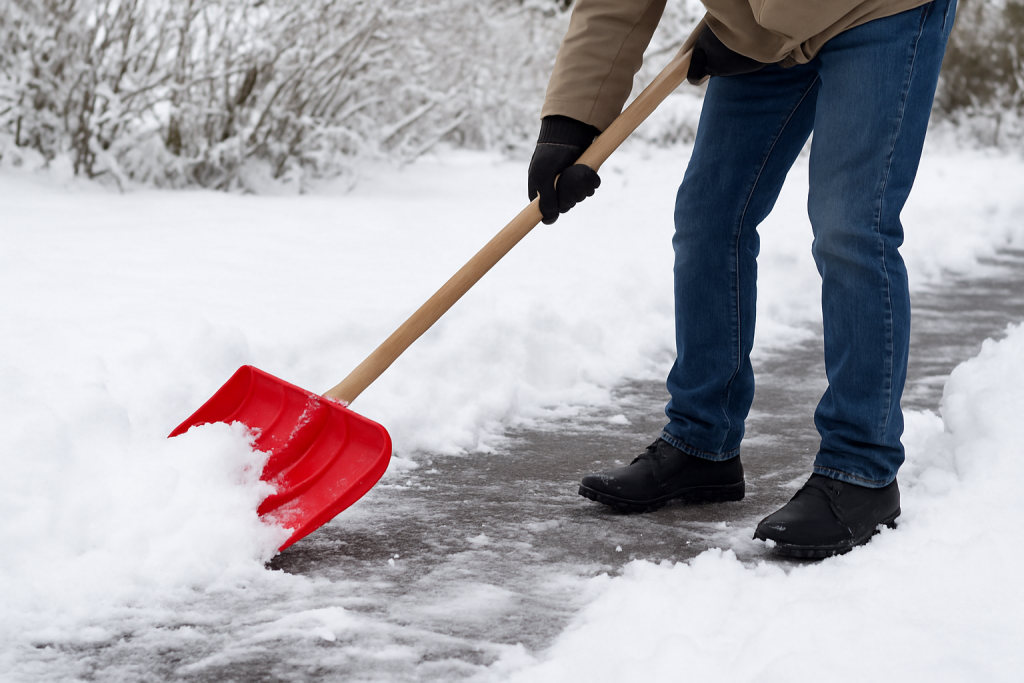
Plastic-edged pushers are generally a sensible starting point for decorative residential surfaces.
They avoid direct metal-on-concrete scraping and can remove substantial amounts of loose snow efficiently.
However, plastic does not mean damage-proof.
A worn blade, trapped gravel or excessive pressure can still scratch or mark a decorative finish.
Inspect the edge periodically, especially after clearing rough or debris-covered surfaces.
Rubber and Other Protective Edges
Rubber or similar protective edges can help reduce direct contact between hard metal equipment and pavement.
They are particularly useful in certain commercial snow removal applications.
Their suitability depends on the equipment, pavement type and operating conditions.
Steel Blades and Scrapers
Steel equipment can be effective at removing compacted material, but it introduces a greater risk of scratching or chipping sensitive finishes.
That doesn't mean steel blades are universally prohibited.
CMHA's guidance for permeable interlocking concrete pavement allows certain steel and hard-rubber plowing equipment, while acknowledging that steel blades typically scratch pavement surfaces.
A tool can be acceptable for maintaining a functional paved area without being ideal for preserving a decorative residential finish.
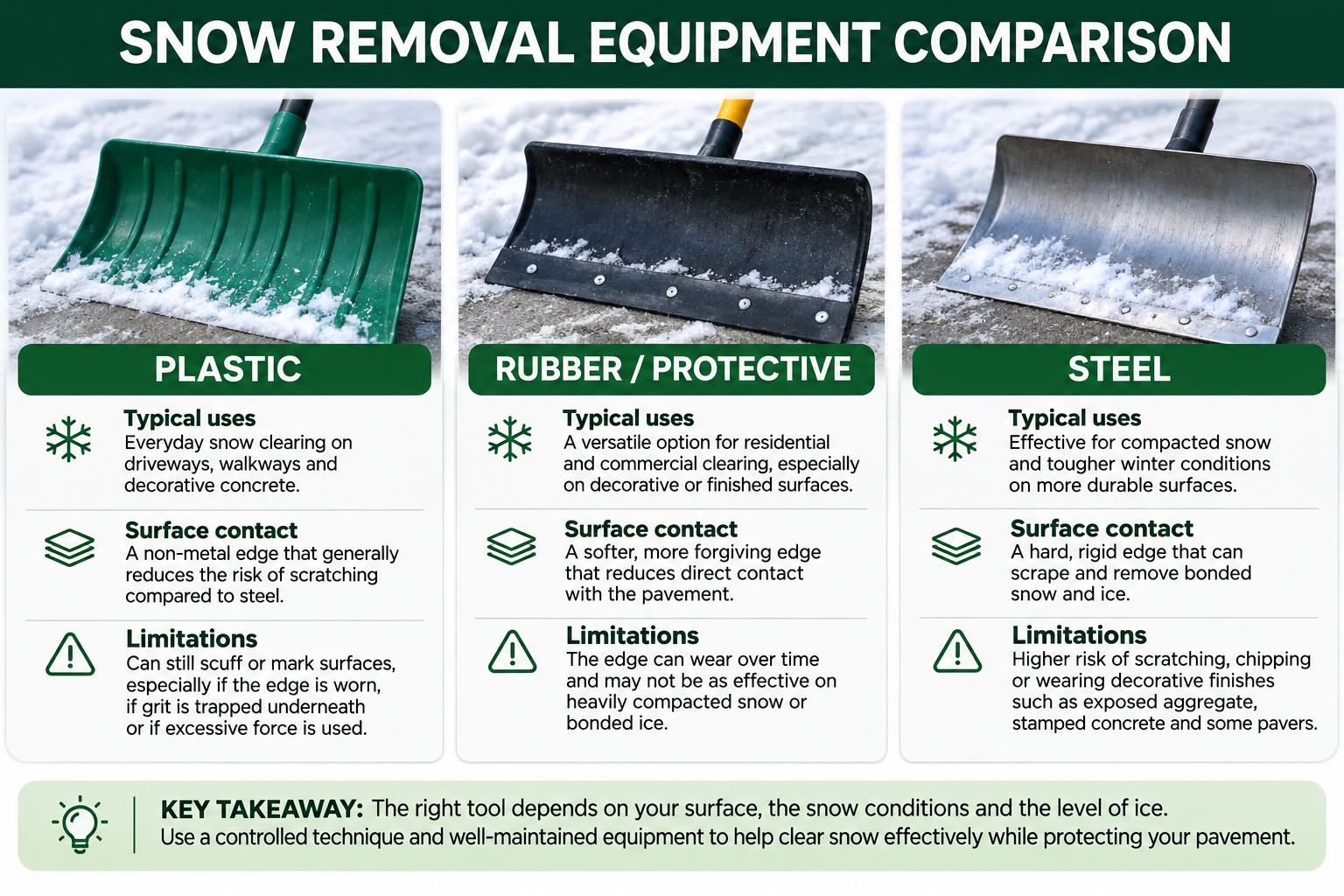
Our advice: For decorative residential concrete, prioritize gentle equipment and proper technique over aggressive scraping.
If snow has become firmly bonded to the pavement, switching to a harder blade isn't automatically the best solution.
Is Ice Melt Safe for Exposed Aggregate and Decorative Concrete?
This is where winter maintenance becomes more complicated.
Many products are marketed as concrete-safe, but that phrase can be misleading when treated as a universal guarantee.
Different de-icers work at different temperatures and interact with pavement materials in different ways.
A chemical's ability to melt ice does not automatically establish its suitability for your driveway.
How Ice Melt Works
Chemical de-icers lower the freezing point of water, helping loosen or melt ice under suitable conditions.
However, the resulting moisture and brine can increase exposure to freezing and thawing. Certain chemical ingredients may also contribute to concrete deterioration through additional mechanisms.
The risks depend on the chemical, concrete composition, surface condition, concentration and exposure.
For that reason, de-icing should never be treated as a substitute for removing loose snow promptly.
What About Different Ice Melt Products?
Sodium chloride (rock salt)
Rock salt is widely used for winter ice management.
Alberta Infrastructure discourages its use on concrete, while CMHA identifies sodium chloride as a preferred option when de-icing certain manufactured concrete pavers is necessary.
Those recommendations address different pavement contexts.
A product that may be acceptable for one paver system should not automatically be considered suitable for a decorative poured-concrete driveway.
Calcium chloride
Calcium chloride is another common de-icing ingredient.
Alberta Infrastructure describes it more favourably than sodium chloride in its technical bulletin, while Concrete Alberta advises avoiding calcium chloride on exterior concrete.
CMHA permits carefully controlled use in certain paver applications.
The disagreement is a useful reminder that there is no universal chemical ranking that applies to every surface.
Magnesium chloride
Magnesium chloride is often marketed for its performance in colder conditions.
However, CMHA advises against its use on concrete pavers because of its potential to degrade concrete.
Melting performance and pavement compatibility are separate considerations.
Fertilizer-based de-icers
Products containing ingredients such as urea, ammonium nitrate or ammonium sulphate should not be assumed suitable for concrete.
Alberta Infrastructure warns that some of these substances can react with concrete.
Ordinary lawn fertilizer is not an appropriate substitute for a purpose-selected winter traction or de-icing product.
Why Do Experts Give Different Recommendations?
One of the most important findings in researching this article is that respected industry organizations do not provide identical advice.
Alberta Infrastructure emphasizes prompt clearing and using sand or gravel where sufficient for safety.
Concrete Alberta generally favours traction sand over chemical de-icers for exterior concrete.
CMHA provides more material-specific recommendations for manufactured concrete pavers, including selected de-icer use under certain conditions.
The differences partly reflect the materials being discussed, but they also reflect differing assessments of chemical exposure and maintenance priorities.
For homeowners, the practical conclusion is straightforward:
Follow the recommendations for your actual pavement, not just the marketing claims on an ice melt bag.
Check the product ingredients, permitted surfaces, application instructions and any restrictions from your installer or coating manufacturer.
For sensitive or newly installed concrete, traction materials may be preferable when they provide adequate safety.
What to Do When Snow Becomes Packed Down or Turns to Ice
Fresh snow is generally much easier to remove than snow that has been compressed by vehicles or foot traffic.
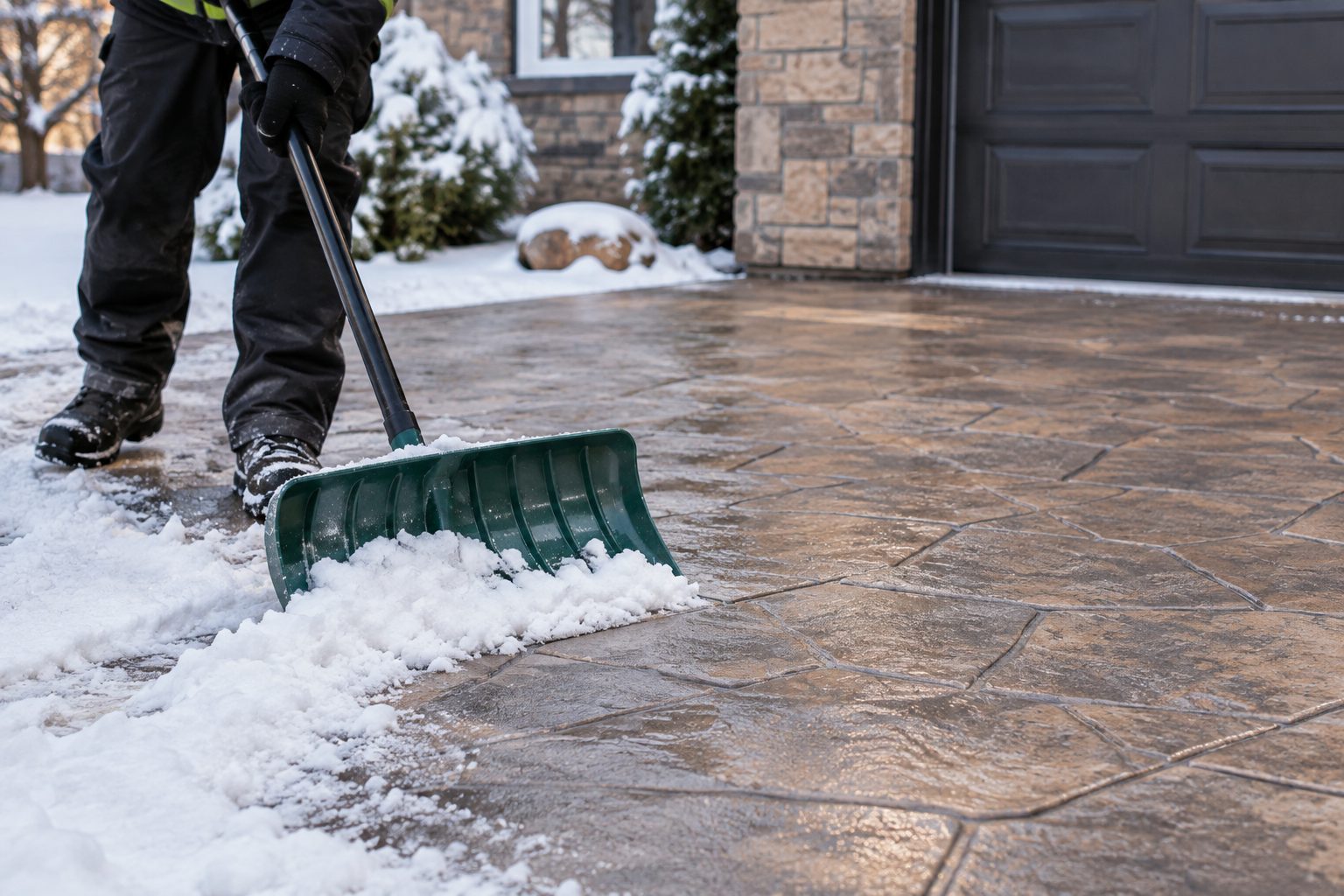
Once moisture freezes against the pavement, removing it becomes more difficult—and potentially more damaging.
The key is to identify the condition before choosing a method.
Loose Snow: Remove It Early
Use a suitable shovel or snow pusher to remove loose accumulation before it compacts.
This is the simplest and generally least aggressive stage of winter maintenance.
Packed Snow: Work Gently
Try controlled passes to remove material that releases without excessive force.
If the snow is firmly compressed into the surface, repeatedly striking or scraping harder may increase the risk of damage.
Stop and reassess the method.
Bonded Ice: Avoid Forceful Chipping
Ice bonded to decorative concrete should not be attacked with repeated blows from a metal scraper.
Alberta Infrastructure cautions against scraping or chipping unless partial melting has already loosened the ice.
Where the surface manufacturer permits it, a carefully selected de-icer may help release the bond.
Where chemical treatment is prohibited, the remaining options may be limited.
Refrozen Surfaces: Prioritize Traction
Even after snow is cleared, meltwater can refreeze into a thin, slippery layer.
Suitable traction materials can improve grip without necessarily melting the ice.
Remember that conventional and permeable pavers may require different materials.
If an essential walking route remains unsafe, restrict access where practical and establish a safer alternative.
Important: Waiting for warmer weather is not an adequate solution when people must continue using a hazardous walkway without appropriate precautions.
Five Winter Maintenance Mistakes That Can Damage Your Driveway
Most winter surface damage isn't caused by a single dramatic mistake.
It often develops through repeated exposure, unsuitable equipment or maintenance practices that seem harmless at the time.
Here are five avoidable problems.
1. Chipping Harder When Ice Won't Release
If bonded ice refuses to move, additional force may transfer directly into the concrete.
Repeated impacts can damage vulnerable finishes or existing weak points.
Change your approach rather than continuing to strike the same area.
2. Applying More Ice Melt Than Recommended
Using excessive de-icer does not guarantee better results.
It can increase chemical exposure and leave additional residue or concentrated slush on the surface.
Follow product instructions and remove loosened material when practical.
3. Treating New Concrete Like an Established Driveway
Freshly placed concrete deserves additional protection.
Alberta Infrastructure advises avoiding de-icers during the first year.
Plan suitable mechanical clearing and traction measures before winter arrives.
4. Using Damaged or Inappropriate Equipment
A plastic shovel with a damaged edge can still cause problems.
So can a blade that drags trapped stones or abrasive debris across a decorative finish.
Inspect equipment and adjust technique to the surface.
5. Ignoring Drainage and Recurring Refreezing
Sometimes the real problem isn't snow removal at all.
Snow piles, downspouts and poor drainage can direct meltwater across walkways, where it repeatedly refreezes.
If the same area becomes icy after every temperature change, consider whether snow placement or drainage needs to be addressed.
Repeatedly treating the symptom may not solve the underlying problem.
How Neighbourhood Heroes Approaches Sensitive Surfaces
At Neighbourhood Heroes, we understand that every property has different maintenance requirements.
A standard concrete sidewalk, an exposed aggregate driveway and a decorative stamped-concrete entrance shouldn't automatically be treated the same way.
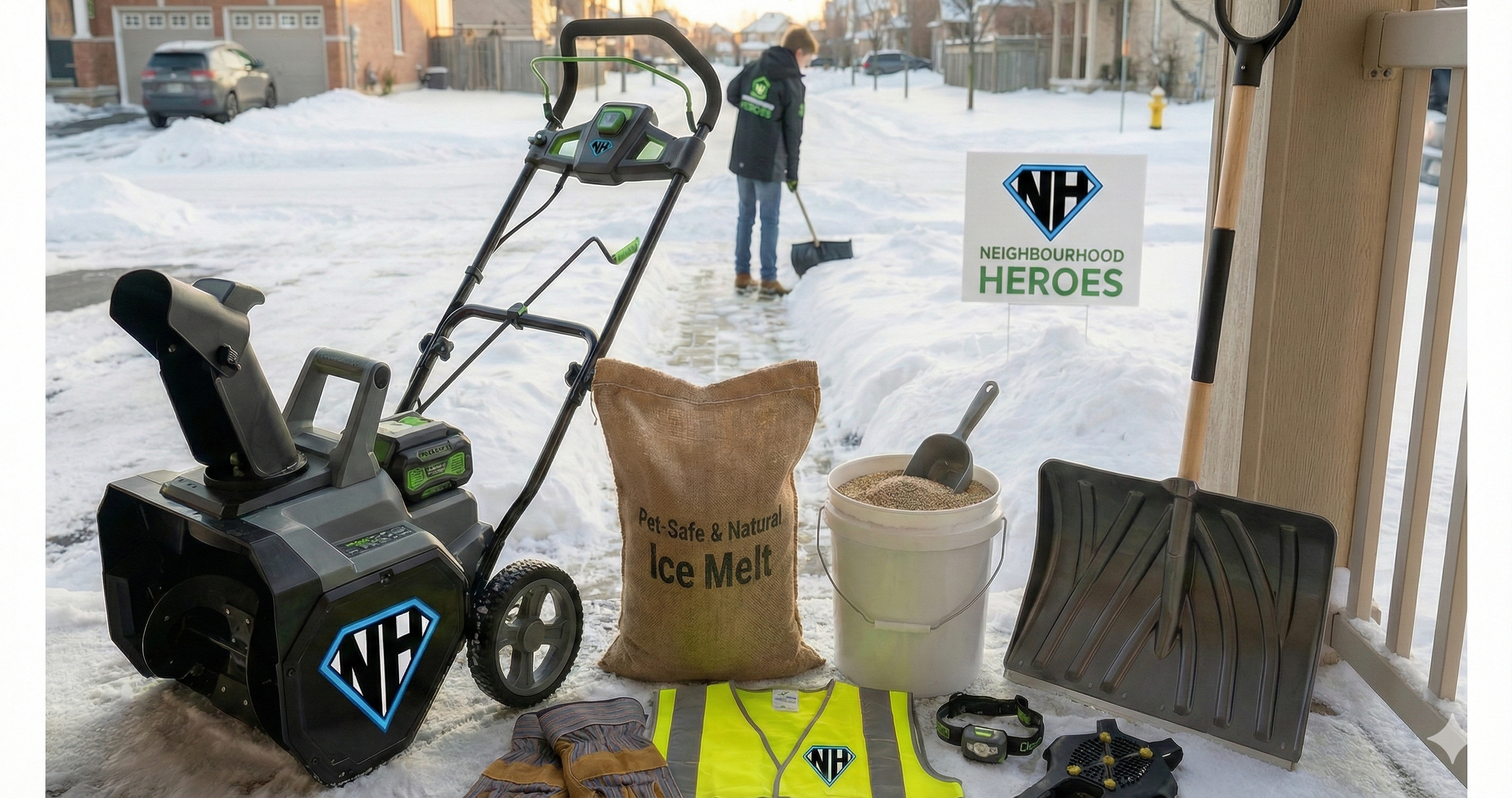
Our snow removal operations combine commercial electric snow equipment with pushers, shovels and other winter tools.
For sensitive decorative surfaces, commercial plastic snow pushers allow our Heroes to clear loose snow while avoiding direct metal-blade contact.
We also encourage neighbours to communicate important property details, including decorative surfaces, existing damage and any installer recommendations.
When operationally feasible, we can accommodate specific instructions, such as avoiding metal blades or refraining from applying ice melt to designated areas.
But we believe transparency is just as important as accommodation.
The Trade-Off Homeowners Should Understand
If both metal scraping and chemical de-icing are prohibited, some compacted snow or bonded ice may remain.
Plastic snow pushers are effective at removing loose accumulation and can loosen some packed snow, but they cannot always remove firmly bonded ice without risking damage.
That means the finished result may differ from a property where more aggressive removal methods are permitted.
We would rather explain those limitations upfront than promise a completely ice-free decorative driveway that we cannot safely deliver.
Our goal is to balance effective snow removal, property protection and realistic service expectations.
You can learn more about our equipment, property information and dispatch approach in our 2026–27 winter operations guide.
Frequently Asked Questions
Can you use salt on exposed aggregate concrete?
Do not assume that rock salt is suitable for exposed aggregate.
Alberta's concrete maintenance guidance generally favours traction sand where adequate for safety, and chemical de-icers can contribute to conditions associated with concrete scaling.
Consider the surface's age, condition and installer instructions before applying a chemical treatment.
Will a plastic snow shovel scratch stamped concrete?
It can.
Plastic generally reduces direct metal-on-surface scraping, but a damaged blade, trapped grit or excessive force can still mark a decorative finish.
Proper equipment condition and gentle technique remain important.
Can you use sand on interlocking pavers?
It depends on the type of paver system.
Suitable traction sand may be appropriate for conventional concrete pavers.
For permeable interlocking concrete pavement, CMHA advises against sand because it can clog the drainage joints. Compatible jointing aggregate is generally preferable.
Should you use ice melt on a new concrete driveway?
Alberta Infrastructure advises avoiding de-icers on concrete less than one year old.
Use gentle mechanical clearing and suitable traction materials instead.
Also consider exposure to salty snow and slush carried onto the driveway by vehicles.
Protect Your Property Without Compromising Winter Safety
Decorative concrete can be a significant investment in your home's appearance and curb appeal.
Protecting that investment through an Edmonton winter requires more than simply choosing the right shovel.
It means understanding the surface, clearing snow before it compacts, selecting ice-management methods carefully and recognizing when further removal could do more harm than good.
The most effective approach balances three priorities: protecting the pavement, reducing slip hazards and setting realistic expectations about what can safely be removed.
If your property has exposed aggregate, stamped concrete or specialty paving, communicate those details to your snow removal provider before service begins.
At Neighbourhood Heroes, we're happy to discuss property-specific requirements and explain which accommodations are feasible.
Explore Our Residential Snow Removal Service
Currently at capacity? You can also join our snow removal waitlist to be contacted when availability opens in your area.
Research and Technical References
The recommendations in this article draw on the following technical and industry resources:
- Alberta Infrastructure — De-Icing Concrete Technical Bulletin
- Concrete Alberta — De-Icing Guidance
- Concrete Masonry & Hardscapes Association — Permeable Pavement Maintenance
- CMHA — Concrete Paver De-Icing Guidance
- Michigan Concrete Association — Concrete Scaling Technical Bulletin
This article provides general homeowner guidance. Always follow the recommendations of your pavement installer, surface manufacturer and product manufacturer. Site conditions and accessibility requirements may call for additional precautions.
What Is the Environmental Impact of Snow Removal Chemicals?
What Are Common Snow Removal Mistakes to Avoid?
No Comments Yet
Let us know what you think